

In this model, inflation has cut yearly leftover money by about $4,209, before tax, at every income since 2023.
Your income may be the same as it was in 2023, yet less of it is left at month's end. The choice in front of you is which side of the budget to work on first.
Statistics Canada reported on November 16 that consumer prices rose 3.1% in the year to October 2026, unchanged from September. Gasoline was the biggest push, up 30.9%. Excluding gasoline, prices rose 2.2%. In Ontario, the yearly rise was 2.5%.
Each year's rise sits on top of the last. From October 2020 to October 2026, all-items prices are up 23.9%. Groceries are up 31.9%, shelter is up 29.5%, and rent is up 32.5%. Food from stores rose 2.0% over the past year, up from 1.7% in September.
How leftover money has shrunk
Estimated average household expenses start at $54,242 in 2023. They rise to $55,554 in 2024 and $56,693 in 2025, following official annual inflation of 2.4% and 2.1%.
The 2026 annual average hasn't been published yet. So the 2026 figure applies October's 3.1% to the 2025 expense, which gives about $58,451.
That's $4,209 more than in 2023, so leftover drops by the same $4,209 at every income, before tax. What changes is the share of income it takes, and that hits hardest where the cushion was smallest.
Incomes in this model are held constant. This is about what a Canadian income can still buy after those expenses are covered, not a claim that pay fell.
This is an illustrative model, not a measured average of households at these incomes. It applies the same estimated average household expenses at every income. Actual essential spending is typically lower at lower incomes and higher at higher incomes.
In this model, here's the figure I'd highlight. In 2023, someone earning $60,000 had 9.6% available after estimated average household expenses, or $5,758. In 2026, that's down to 2.6%, or $1,549. That's essentially breaking even, and that's before tax.
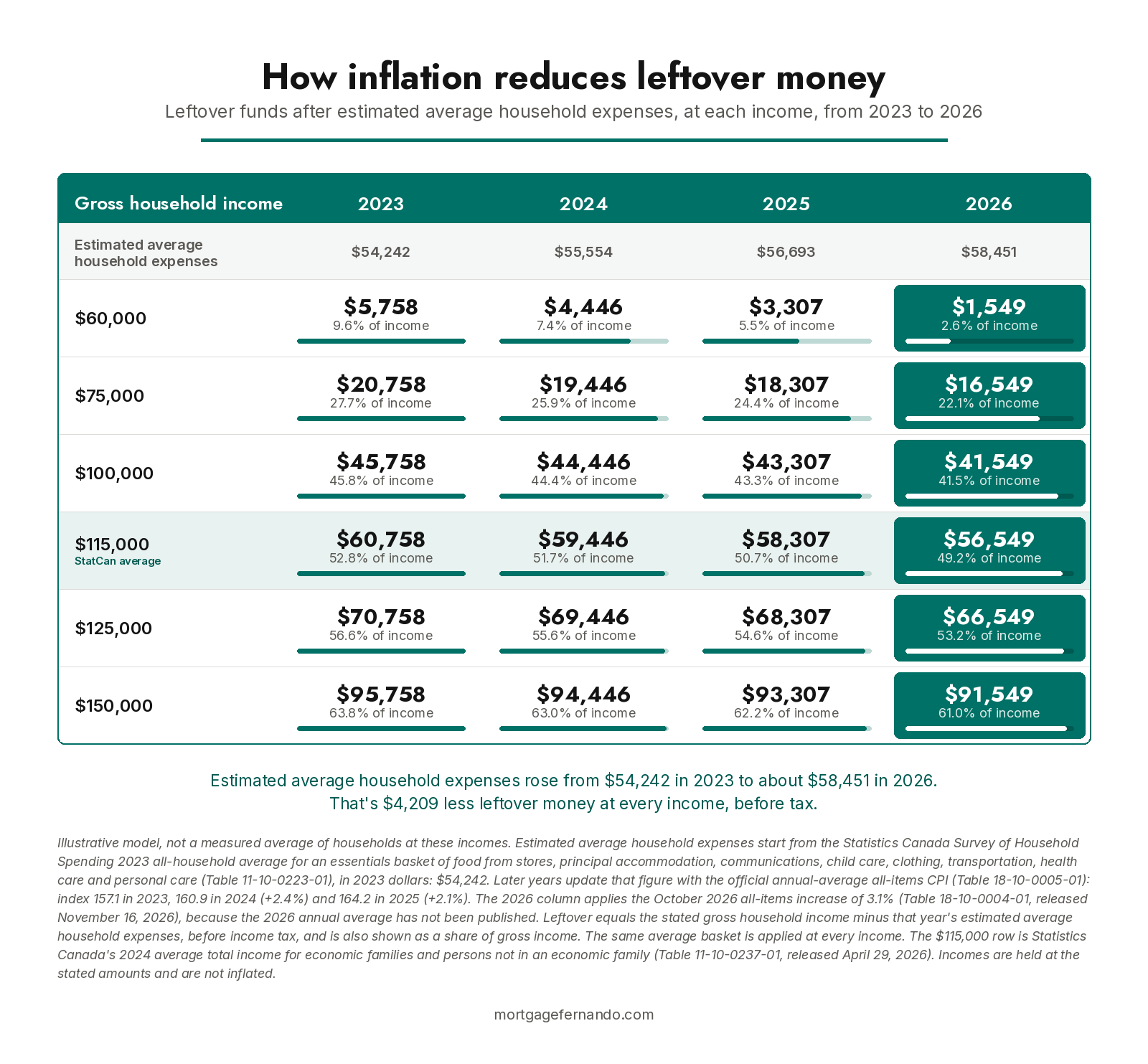
Leftover money after estimated average household expenses, 2023 to 2026, at each income, before tax.
The $115,000 row is Statistics Canada's 2024 average total income for economic families and persons not in an economic family. Leftover there falls from $60,758 (52.8%) in 2023 to $56,549 (49.2%) in 2026.
Both incomes lose the same $4,209. The room that's left is very different.
How I'd think about it
I've watched good families freeze at this step, because the information is everywhere and the answer is nowhere.
To improve your leftover money, there are two paths.
You can try to raise your income, through a new job or by asking for a pay increase. Both depend on others, like a better offer or an employer who can afford an increase.
Or you can reduce expenses. That's the path you can work on from your side, and it's where I'd start. Consolidating debts into a single loan or a mortgage is one of the strategies, not the whole plan.
The plan I'd start this week
- Consider going through your credit-card and bank statements for subscriptions you pay for but don't use. I do this every year. I cancel my credit card and ask the bank to reissue it, so forgotten subscriptions tied to the old card tend to drop off. Then I sign up again only for what I still need. That's my own habit, and it may not catch every charge or suit every situation.
- It may be worth calling your phone and internet providers to renegotiate your contracts.
- Consider paying down high-interest unsecured debt. Say an investment earns 5% and a debt costs, for example, 11%. It may be better to pay the debt than to keep the investment. Selling an investment may have tax consequences, so talk to an accountant first. This is not investment advice.
- It may be worth consolidating debts into a single lower-interest loan or a mortgage, if you qualify. That's a conversation, not a given.
If your expenses are already tight and you carry no high-interest debt, treat this as a check-in, a chance to give your leftover money more room so you can keep paying for the things you enjoy.